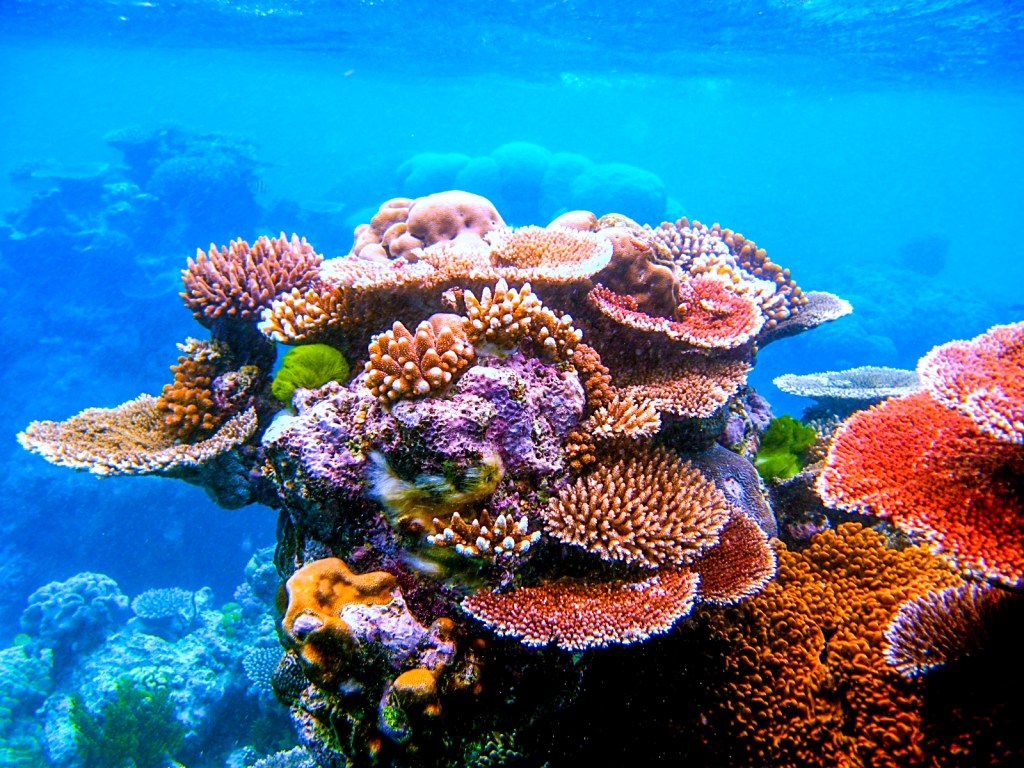
Coral is especially vulnerable to environmental change in the early stages of its life cycle. The combination of the new growth of coral being vital to sustain coral reef health and turbulent environmental conditions due to global warming means it’s more important than ever to study the susceptibility of coral. There are several environmental changes affecting corals such as rising ocean temperatures and ocean acidification. All these factors interlink together to affect the coral’s development and survival rate.
Rising ocean temperatures are the first environmental change that corals are vulnerable to in their early life stages. We are currently at 1.5°C of global warming above pre-industrial levels; if this reaches 2°C, corals will no longer have protection from heat stress (Heron et al., 2022). This will lead to over 90% of coral dying. High temperatures cause coral bleaching as they remove their algae. This causes coral to be much more vulnerable as it becomes structurally weak. It can also reduce their fecundity, meaning they won’t produce as much offspring. A study by (Randall et al., 2015) found that two of the dominating corals in the Caribbean have experienced unprecedented declines due to white band disease. They linked this to rising sea surface temperatures and found a strong positive relationship between the two. It has long been known that temperature increases pathogenic activity in coral. Microbes on the surface of coral can turn pathogenic when exposed to thermal stresses. Corals early in their life cycle are especially suspectable to disease, so increasing disease occurrence would greatly reduce coral survival levels. However, the study was done in the Caribbean and only looked at white band disease. The specific nature of the study means conclusions cannot be drawn universally until further testing is done in different climates with different diseases.
However, some studies have shown that rising ocean temperatures might have some positive indirect effects on early life stage coral. Each year, lots of coral die due to crown-of-thorns starfish (COTS). These starfish ingest coral polyps. However, a study by (Lang et al., 2022) showed that if oceans continue warming at current rates, these starfish might not be able to survive. The study exposed COTS to four thermal treatments. At 32°C, the starfish were 4 times less likely to survive than at 30°C. Therefore, the population of COTS could drop detrimentally if ocean temperatures continue to rise. This would allow more coral to grow fully. However, this study also was carried out with a small sample size (n=48) meaning it was 12 starfish per treatment. A wider study would have to be completed to confirm these conclusions. Also, the natural predation of COTS may reduce with environmental conditions becoming harsher, meaning their numbers will not reduce as much due to predation.
The littering of plastics into the ocean has also been proven to increase disease rates in coral. A study by (Lamb et al., 2018) found that disease was 20 times more likely in corals surrounded by excessive plastics.
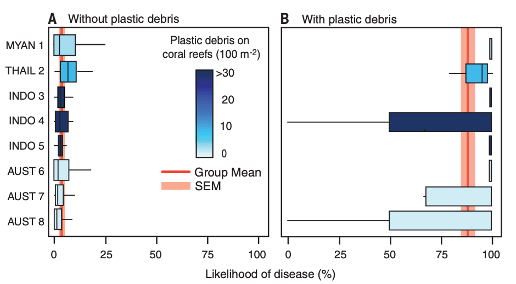
This can be shown in Figure 1, where all coral sites show a much greater probability of disease with plastic debris compared to the control. This is due to the plastics encouraging microbial colonisation and increasing the number of pathogens that live on the reef. Corals have a much lesser chance of surviving their early stages with more diseases present.
Ocean acidification will also affect the early life stages in corals. Due to the rising levels of in the atmosphere, the ocean dissolves the gas and converts it into bicarbonate. This turns the sea more acidic. During the early stages, this leads to the corals growing weaker skeletons and less infilling of corallite due to a lack of carbonate ions. This makes them much more likely to be damaged by waves, also meaning there won’t be as many coral sites for larvae growth. Global warming also increases storm frequency, meaning more waves will be hitting reefs. These corals are already weaker, so the increased environmental pressure from wave frequency means they’re much less likely to settle and survive. It also does not just produce weaker skeletons but also grows them slower. The more acidic conditions cause calcium carbonate to be produced more slowly, which is the main component of these skeletons.
Finally, warmer waters can increase the growth ability of algae due to it helping with photosynthesis. This will promote algae growth, meaning there is less room for coral. Slowly, these coral reefs will become covered with algae. Not only does algae inhibit coral growth, but it can also alter the bacteria and nutrient concentrations in the water (Vega-Thunder, 2012). Therefore, even if the algae gives the coral room to grow, it will be disadvantaged by the conditions and not grow to maximum health or strength. To conclude, early life stages in coral are extremely vulnerable to environmental changes. These changes do not only drastically reduce their chances of survival, but also reduce their reproductive capabilities. If coral reefs are to survive, drastic reversal is needed on climate change in order to stop the acidification and warming of the oceans. Failure to do this would cause the only solution for the majority of reef growth to be artificial. This is not feasible due to cost and time pressures.





 Harri Roblin
Leave a comment