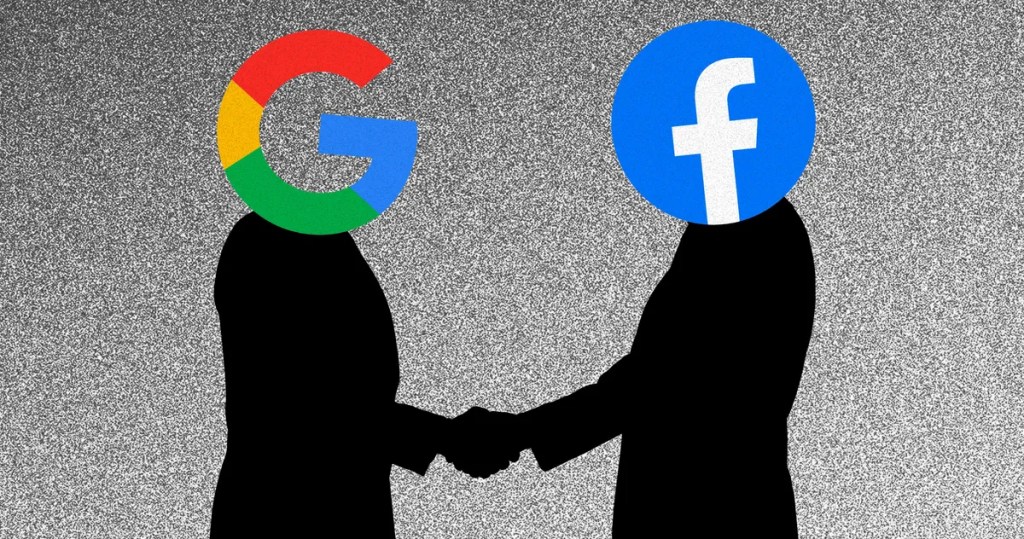
The Jedi Blue agreement was an agreement between Google’s Open Bidding and Meta, owned by Facebook, Audience Network programme. Google’s Open Bidding is an advertising programme that allows the client to bid for ad space in an auction setting. A request for an ad is sent to a google ad manager which will select the best ad option already available in its system. The request will then be dispatched to multiple other ad networks. Each ad network will conduct its own individual ad auction where the optimum bid is selected. The value of the optimum bid is then returned to the ad manager where they all compete in a first price unified auction. The winning ad of the unified auction is then returned to the publisher for the ad to be posted. In general terms, Google’s Open Bidding acts as an auctioneer for bidders to buy ad space on publishers’ websites. Google’s Open Bidding is a key software that gives businesses, big and small, the opportunity to monetise their websites and generate extra income. Depending on the business’s situation, this can either keep them afloat or help them prosper.
Meta’s Audience Network operates in the same market but holds a different purpose. It serves as an app advertising network. In simple terms, this is a system that allows app developers to monetise their apps by showing targeted ads. The Audience Network uses people’s interests and profiles to show topic-specific ads which will interest the consumer the most. The programme then uses real time impression data to show how successful the allocations are. Based on this data, the distribution of the ads might change slightly if certain demographics are not responding to specific ads in a positive way. Unlike Google’s Open Bidding system, the Audience Network is more of a bidder than auctioneer as they pay companies to place advertisements on their websites or apps. The positive of this is that it allows maximum consumer and supplier happiness. With the ads being more targeted, consumers are much more likely to be interested in the products and generate more impressions. According to Meta, conversion rates of their targeted ads were eight times higher than the non- targeted ads on Facebook (Meta Business Help Centre, 2023). The other positive about Meta’s system is their ability to run the varying types of ads. This allows them to find ads for any situation (app or website).
The Jedi Blue agreement is very controversial due to the nature of the deal. The premise is that Google give Meta preferential treatment in their Open Bidding algorithm. This involved giving Meta the first choice at the best advertisement placements and allowing them more leniency when considering their bids. In exchange, Meta promised not to build a competing header bidding technology which they had previously planned to release in 2018. They also agreed not to support any rival ad auctioneering system (Lomas, 2022).
As there is no official joining of technology or algorithms, this is a vertical alliance rather than a merger, involving some horizontal collusion. Vertical alliances are relationships where two companies from the same supply chain collaborate. In this example, Google, the auctioneer, and Meta, the bidder, are collaborating to lower competition in the market. There are many positives to a vertical alliance. Firstly, vertical alliances are proven to have more organisational trust than horizontal alliances (Rindfleisch, 2000). Organisational trust is the ‘confidence in an exchange partner’s reliability and integrity’ (Morgan, 2013). The two firms not being direct competitors allows for more trust and willingness to share ideas. This is a huge positive as if the two firms are more willing to share concepts and ideas, it allows for greater collaboration and productivity. However, horizontal collusion has very negative consequences for the advertising market. As this is competitors at the same market fixing the outcome of the auction and price, it is a very anti-competitive practice for the ad market. This will be covered later in the essay.
Another reason for Google collaborating with Meta is consumer’s cognitive bias. Google is such a large name already and with the incorporation of Meta, it becomes arguably the largest alliance worldwide. When clients are choosing which header bidding system to use, they are far more likely to pick Google’s Open Bidding compared to others due to the company attached to it. It becomes an irrational decision, with the consumer assuming that Google and Meta’s technology will be superior to any of its counterparts. Linking to this, Meta are one of the only companies that have as large a brand as Google in the ad market. The added incentive to Google of stopping the planned Meta project to create a new ad technology far outweighs the cons of giving them a reduced price. Therefore, not only does this deal stop the reduction of Google’s own audience but it allows them to expand its own market reach utilising Meta’s Audience Network.
Meta’s Audience Network technology also allows for more targeted ads for Google’s clientele. The data Meta has collected about consumers means that they can pick ads that will obtain the most interactions. This is a win-win for all parties. Website owners will gain the most revenue from their ads, the ad producers gain the most exposure for their products while Google and Meta obtain better reputations due to their ad placements success. This also allows Meta to collect more information about consumers preferences for their Audience Network. For these two companies, the deal is ideal as it is a cycle which will consistently improve as they collect more diagnostics as time progresses.
Due to the nature of the deal, the European Commission have started an investigation on the ‘Jedi Blue’ agreement. They are deciding whether to block the deal on economic grounds. To explore this, it is important to look at welfare implications of the agreements on parties involved, especially clients.
The agreement between Google and Meta was first registered in 2018 under the code name ‘Jedi Blue’. Shortly after the agreement, they announced the transition to unified first price auctions to ‘increase transparency for everyone in the ecosystem’ (Bigler, 2019). However, a paper by (Geradin and Katsifis, 2019) found that this switch in fact reduced the auction transparency. Due to their competitive dominance, Google were already charging hidden fees in the form of ad intermediation. First price auctions allowed them to increase the margin they charge. The deal gives them more market power as an oligopoly, which means they can charge closer to monopoly prices. The hidden nature of the auction also decreases competition. Google can just inform Meta of the highest current bid so Meta can outbid and win the auction. The action alone undermines the promise to their consumers of running header bidding, which is meant to be one of the fairest ad selling practices. This horizontal collusion results in significant welfare loss for clients and website publishers as clients do not win ad space and Meta might have paid more to website publishers if they did not know the highest bid. If proven, this would be seen as anti-competitive by the European Commission and both sides would be sanctioned. An example of the European Commission blocking a similar deal as it inhibits competition is shown in this paper (European Commission – European Commission, 2023). The ‘acquisition of Daewoo Shipbuilding & Marine Engineering CO., Ltd (DSME) by Hyundai Heavy Industries Holdings’ was deemed to make the merged company too powerful, so was blocked. It is in the Commission’s best interest to not allows deals like this occur to keep consumers happy and prices lower. This shows they would not hesitate to block this deal.
One of the Commission’s main concerns is ‘that the agreement may form part of efforts to exclude ad tech services competing with Google’s Open Bidding programme’ (European Commission – European Commission, 2023). The ad market is already very saturated and they do not want to allow Google to gain too much market power. For this reason, I think the European Commission will move to block the deal on economic grounds. It is in their best interest to stop deals like this happening to discourage the largest companies from merging to gain monopoly level market power. By banning the alliance, they will encourage competition within the market. It is even a possibility they sanction both Google and Meta if they are able to prove collusion has occurred. The EU and the UK are working in tandem on this probe. This might suggest the importance of it and show they have a real argument to block the deal. With the joint resources of the two commissions, they have a large amount of investigative tools to prove the collusion at play.






 Harri Roblin
Leave a comment